

TVC
Project Summit was originally built around the development of Thrust vector Control systems for model rockets. This involves moving the motor within the rocket to keep the vehicle stable and on its trajectory, rather then relying on aerodynamic surfaces such as fins.
How It Works
The flight computer takes acceleration and angular velocity measurements from on-board sensors (Inertial Measurement Unit, IMU). This data is used to find the vehicles orientation, so the computer knows how much the rocket is tilting off-course. The vehicles orientation is fed into a control loop, which uses a PID control system. This control system calculates what angle the rocket should set the motor to, in order to keep the rocket aiming straight up. Finally, the flight computer sends the signals to the TVC mounts X and Y servos, and the rocket attempts to steer itself back into the right direction.
Hardware Meets Software
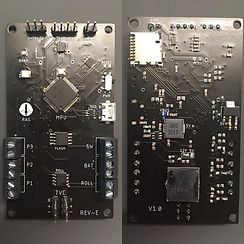
A fancy flight computer is great and all, but this is useless without extensive control software installed on it. Control software has been developed over many months of testing, this was and still is one of the most challenging aspects of Project Summit. I would love to show the software and walk through how it works, though unfortunately I could get into legal trouble. Visit the resources page for some useful resources on this.
TVC Mount (Gimbal)
The current TVC mount, used on both flight attempts, is the third version (I think?). Each version has been optimised to be better then the last, until the current design was reached. The gimbal can tilt approximately 5 degrees on each axis, giving the rocket plenty of control authority.
